Pardis Ghasemi Rashksofla / July 12th 2025 At Koganei Chateau Arcade B1F (former bowling alley site) / Tokyo, Japan
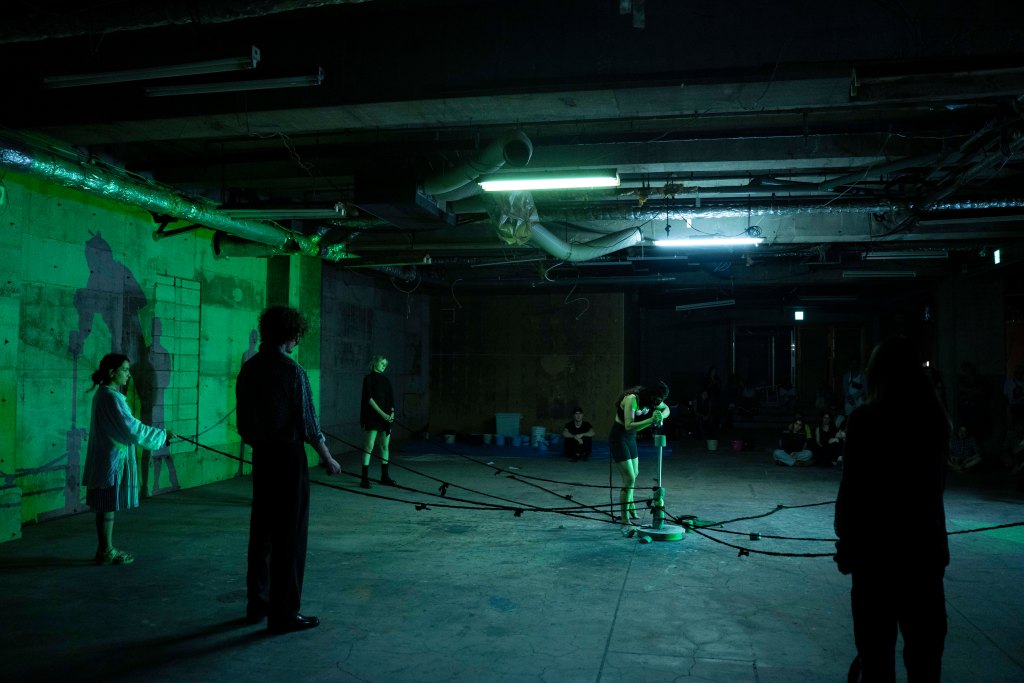
Between Bombs and Blasphemy stages a slow, deliberate unraveling of ideological violence—both the kind that builds walls and the kind that drops bombs. This performance is set against a terrain marked by internal repression and external aggression, where political bodies are both regulated and violated. It is a space where power, belief, and collective memory are deconstructed and reassembled through ritual and resistance.
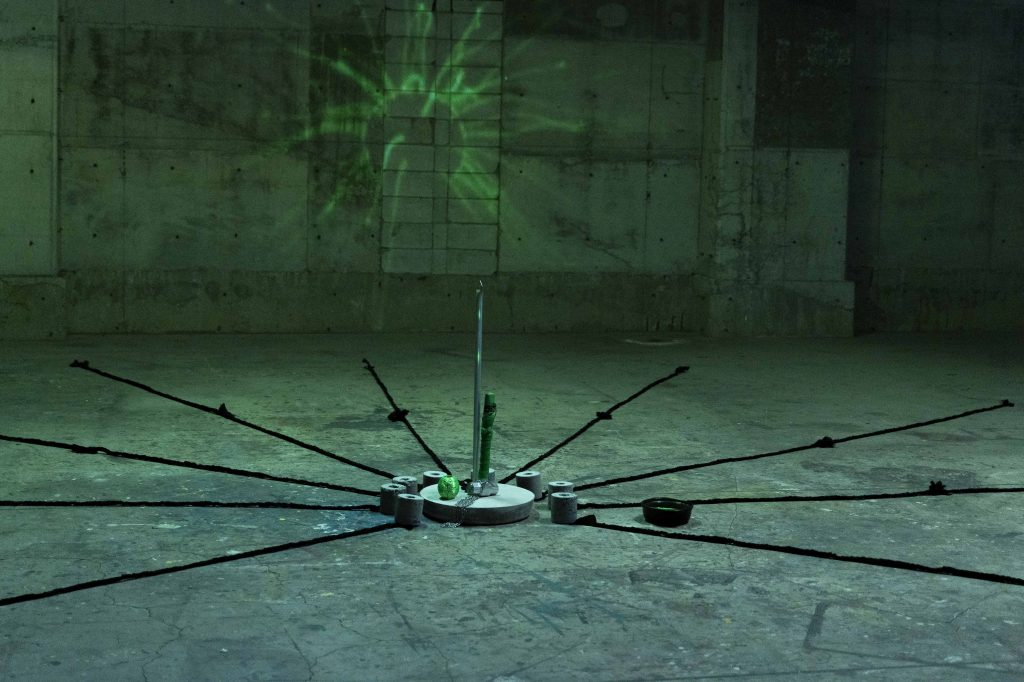
At the heart of the work stands a cylindrical metal pipe with a slightly flared, pointed tip, rising from a concrete pedestal. Surrounding this central element are eight hollow concrete cylinders, each pre-drilled with a narrow cavity designed to accept the pipe’s tip—but only under force. With a rhythmic precision, the artist takes a hammer from which a chain dangles, echoing the Shia ritual of self-flagellation performed in remembrance of Imam Hussain. This chain is momentarily employed in a mourning gesture, a brief invocation of Ashura, before the ritual proceeds to construction.
The performance begins with a re-envisioned act of wudu, the Islamic ablution ritual. Instead of water, a neon green liquid is used—its unnatural fluorescence suggesting both ritual purification and the contamination of trauma. The performer methodically washes her face, arms, and feet, each movement imbued with both inherited ritual and contemporary crisis.
Then, one by one, the concrete cylinders are brought to the central pipe. With each decisive blow of the hammer, a cylinder is driven down. Two of the eight cylinders fracture under the force, while the remainder slide into place along the metal shaft. As each cylinder is fitted, the performer lays out a long, black braid—crafted from fabric that emulates the texture of the chador, the hijab celebrated by state narratives. One end of each braid is gently pressed against the freshly installed block, while the other end is silently offered to a selected member of the audience. They do not volunteer; they are summoned. With this exchange, spectators become participants, their quiet holding of the braid transforming them into active witnesses to the process.
Notably, one final cylinder resists complete insertion. Its stubborn half-entry creates a visible gap—a testament to a regime that tries, but cannot, fully construct its vision. In that moment, the performer lies before the incomplete monument, a body both exposed and defiant.
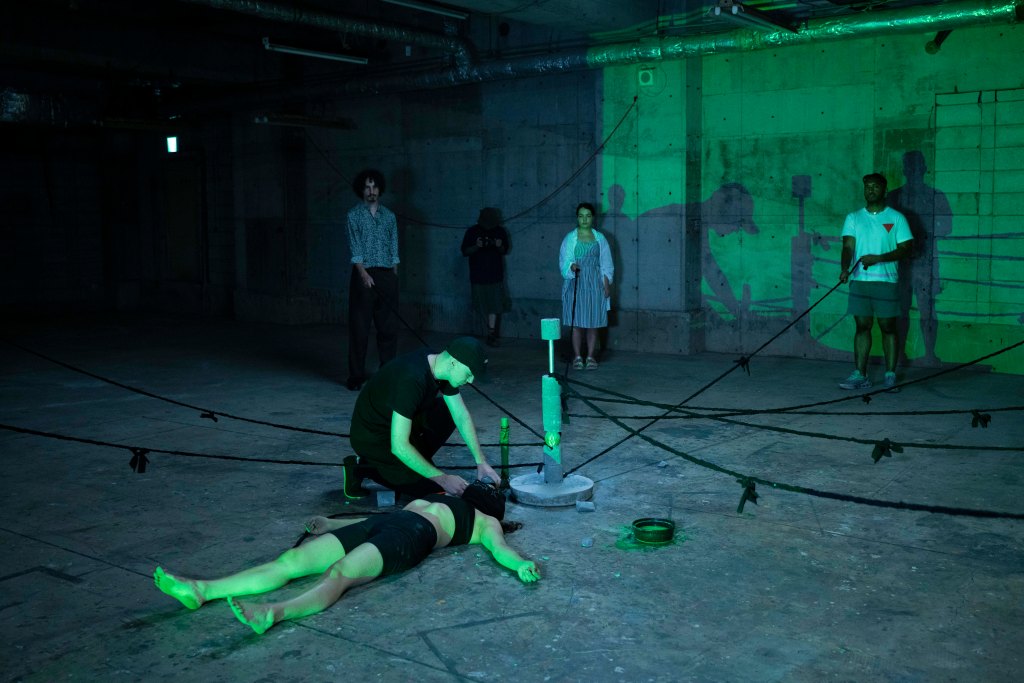
Then enters a second figure. With deliberate calm, he steps forward and draws: first a bomb onto the concrete tower, then a B-2 bomber onto the exposed belly of the artist. This act etches the mark of external military aggression onto both the constructed symbol and the body that has borne the load.
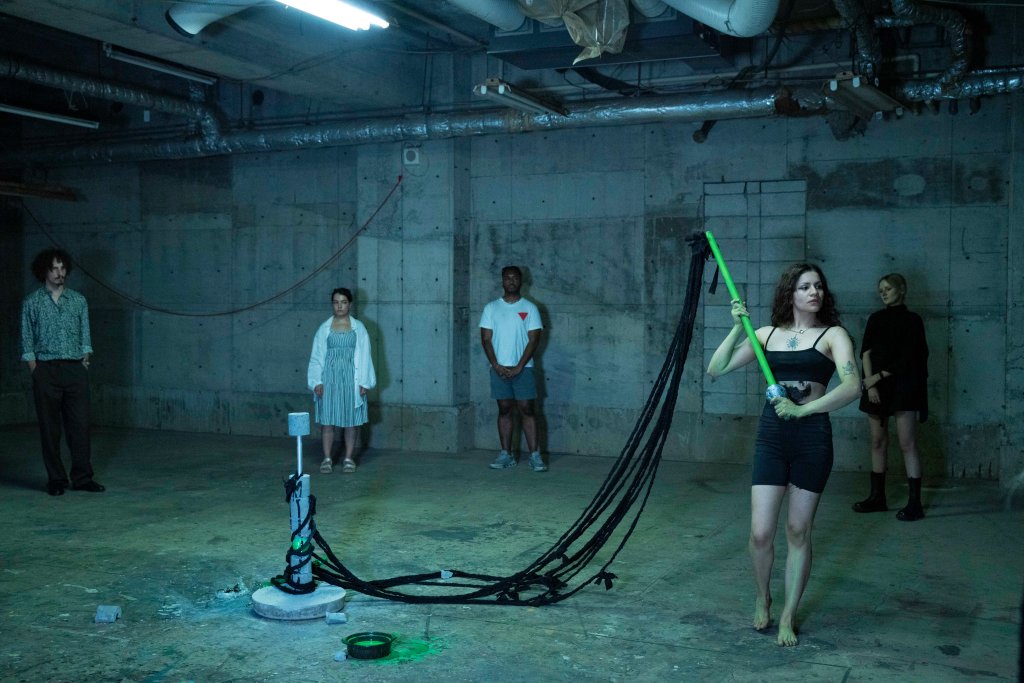

Following this, the performer removes her mask and rises. She gathers the loose, outstretched ends of the black braids—each one a thread of shared witness—and weaves them into a makeshift flag. This flag is then carefully inserted into the gap left by the unfinished cylinder, an act of reappropriation that transforms a wound into a banner of collaborative resistance.
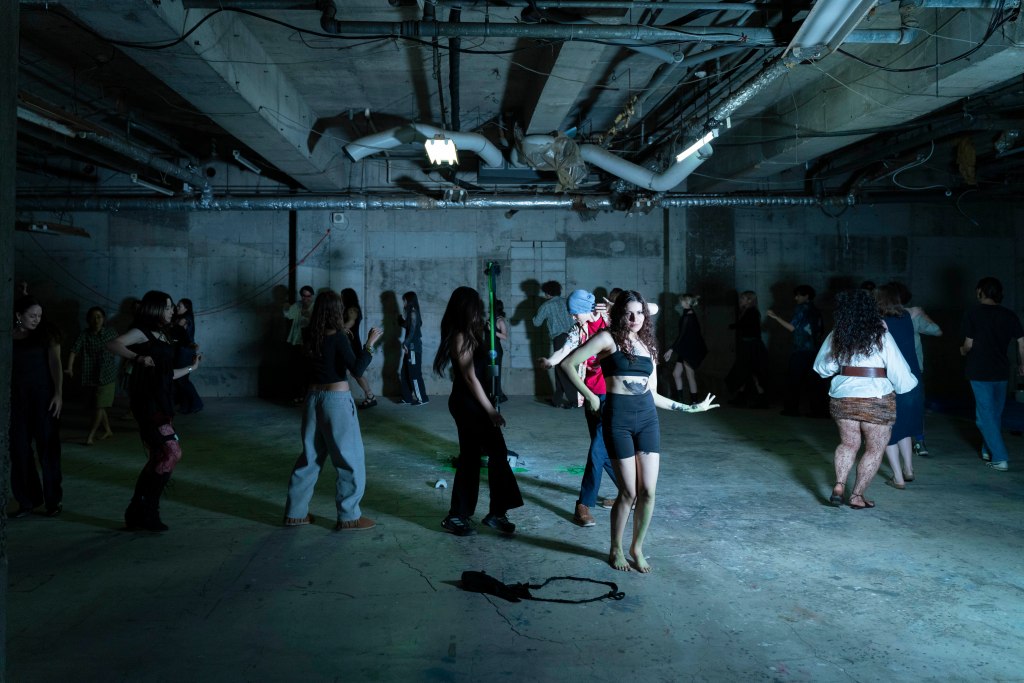
The performance ends not in silence, but in dance. It unfolds as an unrehearsed, unresolved, yet resolute choreography of survival. The individuals who join the dance come from a diversity of cultural, ethnic, and gendered backgrounds. Each one moves in their own language of rhythm and resistance—there is no prescribed Persian dance workshop, only a mosaic of personal expression. In this moment, the fragmented pieces of the performance coalesce into a fragile constellation of difference, united by shared defiance and the desire for liberation.
⸻
“To a tangle of blasphemy
welcome to a cloister inside me…”
“Press me—
like a rabid dog,
I’ll dance the Arabic dance
amid floods and earthquakes.”
“I am all the perished tribes.
I am ʿĀd, Thamūd, and Lūṭ…”
“Reveal it.
A whip so long—
water in excess—
for I have already turned to stone.”
These verses, written by an Iranian peer (M.J Sadeghi-nasab from their poem book titled Gehenna), reverberate with the performance’s layers of ritual, mourning, and subversion. They remind us that amid the forces which bind and break us, there lies a call to both disassemble and rebuild—a yearning to transform suppression into the seed of a fragile, yet undeniable, liberation.
⸻
Between Bombs and Blasphemy / Video Archive
Video by Kana Sun, 31minutes
Between Bombs and Blasphemy is not simply a narrative about state control or foreign military might. It is a meditation on the ways in which internal and external forces clash against our bodies, histories, and futures—and how, through collective acts of holding and dancing, we might begin to reclaim the spaces where power once reigned. It is an invitation to witness that liberation, even in its most uncertain form, grows in the tender, often unexpected, intersections of our lives.
Photo documentation by Chanleyrew
 COLLAPSE.SYSTEMS